Body contouring · Planning guide for international patients
Liposuction in Turkey
What liposuction can and cannot remove, how areas and techniques change the plan and the price, and how to judge a quote before you travel to Turkey.
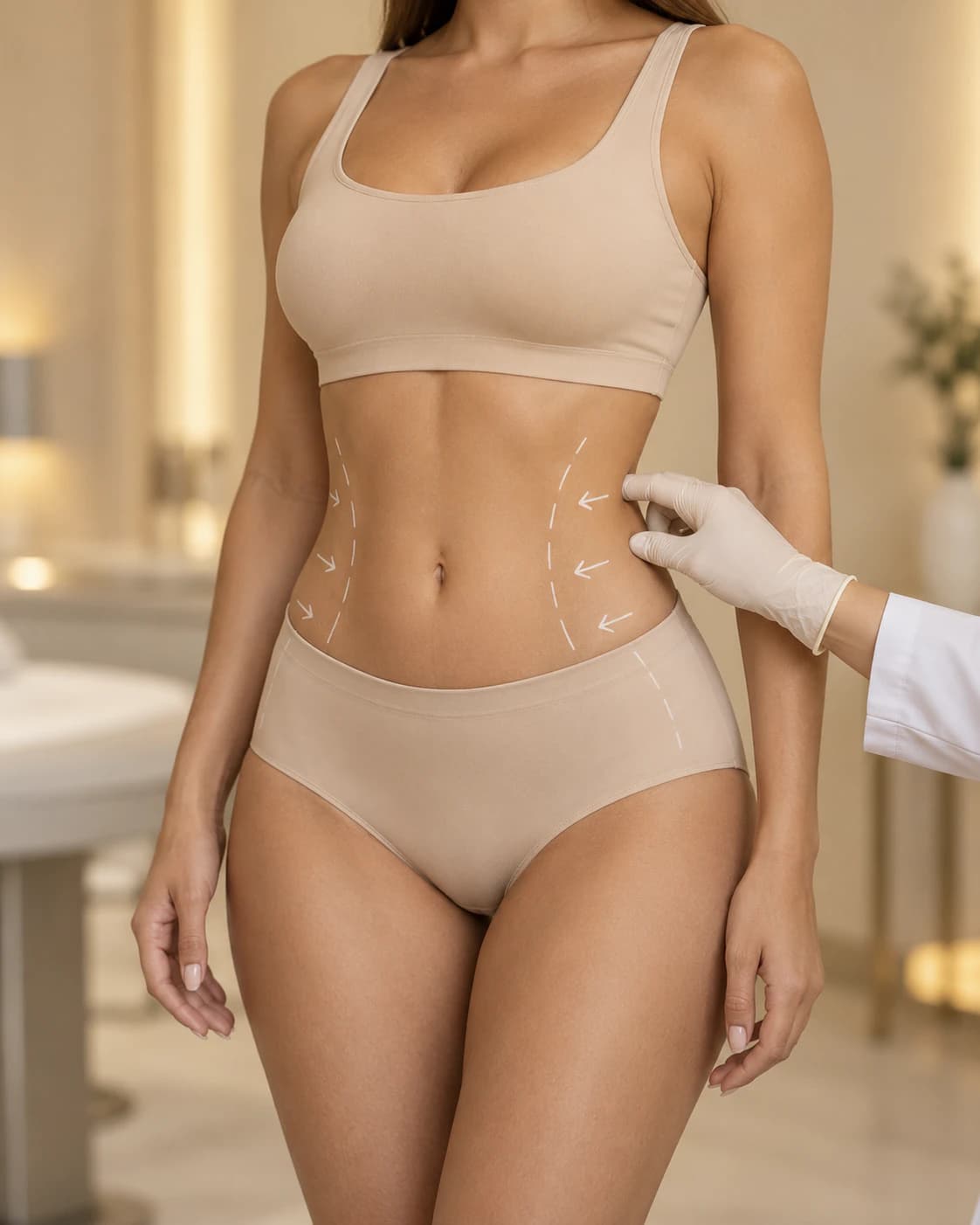
- Hospital stay
- Day case or 1 night
- Recommended Turkey stay
- 5–7 days
- Initial recovery
- 5–7 days
- Final result
- 3–6 months
Liposuction removes stubborn deposits of fat through thin tubes called cannulas to change the shape of specific areas such as the abdomen, flanks, thighs, arms or chin. In Turkey it is often priced per treated area or as a multi-area package.
Liposuction reshapes; it does not treat excess weight, loose skin or cellulite. How much it can improve your shape depends on where your fat sits, how elastic your skin is and how many areas are treated safely in one session. Those factors decide the plan — and the price — and they can only be judged properly at an examination.
01
What Liposuction Can and Cannot Do
Liposuction works on the fat under the skin (subcutaneous fat), not the fat around internal organs. It can:
- reduce localised fat that has not responded to diet and exercise
- refine proportions — waist to hips, abdomen to flanks, thighs to knees
- improve the outline of the chin, arms or back
It cannot:
- produce significant weight loss; the scale may move little even when clothing fits differently
- tighten loose, overhanging skin — that usually needs a skin-removal operation such as a tummy tuck
- remove stretch marks or reliably improve cellulite
02
Is Liposuction Suitable for You?
Liposuction generally suits people who are close to a stable weight, in good health, and bothered by fat in particular areas. A surgeon will consider:
- Skin quality. Firm skin contracts over the new contour; lax skin may sag or wrinkle once fat is removed.
- Where the fat is. Fat under the skin responds; firmness from abdominal muscle separation or fat inside the abdomen does not.
- Weight stability. Remaining fat cells can enlarge if you gain weight, in treated and untreated areas.
- Health and medication. Blood-thinning drugs, bleeding disorders, heart or lung conditions and smoking all change the risk.
- Plans for pregnancy or major weight loss, which can undo or change the result.
03
Areas Treated, and How Many in One Session
Common areas include the abdomen, flanks ("love handles"), lower back, outer and inner thighs, knees, upper arms, chin and neck, and the male chest. Clinics in Turkey often describe multi-area combinations such as "360 liposuction" around the waist.
Treating more areas is not only a matter of price. Every additional area adds operating time, fluid shifts and swelling, and increases the demands on recovery. Surgeons set limits on how much fat is removed in one session according to your size and health, and some patients are advised to stage treatment. Ask your surgeon what is safe to combine for you, and why.
| Area | What surgeons typically assess | Planning note |
|---|---|---|
| Abdomen | Skin laxity, stretch marks, muscle separation, previous scars | Loose skin or a bulge from separated muscles may point to a tummy tuck instead |
| Flanks and lower back | Fat distribution around the waist | Often combined with the abdomen to change the waist from all angles |
| Thighs and knees | Skin thickness, cellulite, symmetry | Inner thighs have thinner skin and can show irregularities more easily |
| Upper arms | Skin quality and hanging skin | Hanging skin may need an arm lift rather than liposuction alone |
| Chin and neck | Skin elasticity, neck muscle bands | Fat alone responds; loose skin or bands may need a neck lift |
| Male chest | Fat versus firm gland tissue | Gland tissue usually needs excision (gynecomastia surgery) |
04
Liposuction Techniques Used in Turkey
Most liposuction today starts with tumescent infiltration: a large volume of fluid containing diluted local anaesthetic and adrenaline is injected into the area to reduce bleeding and pain. The total local anaesthetic dose is calculated for your body weight, which is one reason treatment limits exist.
| Technique | How it works | Often chosen for |
|---|---|---|
| Suction-assisted (traditional tumescent) | Fat removed mechanically with cannulas | Most areas; the reference technique |
| Power-assisted (PAL) | A vibrating cannula helps the surgeon move through tissue | Larger volumes and fibrous areas |
| Ultrasound-assisted (including VASER) | Ultrasound energy loosens fat before suction | Fibrous areas such as the back or male chest; high-definition contouring |
| Laser-assisted | Laser energy applied under the skin | Selected small areas; heat adds a burn risk |
No technique is best for everyone, and results depend more on the surgeon's planning and skill than on the device named in an advertisement. If ultrasound liposuction is recommended for you, read VASER liposuction in Turkey; for visible muscle definition, abdominal etching is a separate, more exacting procedure.
05
What Can Change After the Examination
Photographs cannot show skin tone, fat thickness or muscle separation reliably. At examination, a surgeon may:
- recommend fewer areas in one session, or staging treatment
- advise a tummy tuck, arm lift or thigh lift because skin is looser than expected
- change the technique
- postpone surgery because of weight, blood tests or a health issue
Ask before travelling how each change would affect the price and your deposit.
06
Liposuction Cost in Turkey
In September 2026, Turkish clinics most often advertised liposuction of one area from about €2,000 to €2,500 in an all-inclusive package, with each additional area typically adding several hundred euros. Combined abdomen and flank packages were commonly advertised at roughly €3,000–€5,000, and ultrasound or laser techniques were usually priced higher than traditional liposuction.
These are advertised starting prices and package estimates from providers' websites and booking platforms, not quotes. How clinics define an "area" varies, so compare quotes by the exact zones listed, not by the number of areas.
| Cost factor | Why it may change the price | What to confirm |
|---|---|---|
| Number and size of areas | More zones mean longer surgery and more fluid and garments | The exact zones included, marked on a diagram if possible |
| Technique | Ultrasound, power or laser devices can add cost | Which technique is used and why |
| Volume and body size | Larger volumes can need an overnight stay and more monitoring | Whether an overnight hospital stay is included |
| Anaesthesia | General anaesthesia or sedation by an anaesthetist changes the fee | Type of anaesthesia and who gives it |
| Facility | Hospital or licensed day-surgery setting | Where surgery takes place |
| Compression garments | Garments are worn for weeks; some packages include one, others two | Number of garments included |
| Aftercare | Lymphatic massage or extra checks are sometimes sold separately | Which post-operative visits and treatments are included |
| Travel services | Hotel nights and transfers vary | Hotel standard and cost of extra nights |
The same operation abroad
The UK and US figures are published by each country's own national body; the Türkiye range is the one recorded on this site from Turkish providers. Nothing is converted between currencies, and the US figure is a surgeon fee that excludes anaesthesia and the operating room — so the real US total is higher than shown.
| Procedure | TürkiyeAdvertised package prices | United KingdomNHS — typical private total | United StatesASPS — surgeon fee only | Continental EuropeNo published source |
|---|---|---|---|---|
| Liposuction | €2,000 – €5,000 | £3,000 – £8,500 | $4,711Surgeon fee only — not a total | Not published |
What each figure includes
Türkiye
€2,000 – €5,000What the figure covers
Range of prices advertised by Turkish providers
Observed on provider websites by this siteRecorded 2026-09-15
United Kingdom
£3,000 – £8,500What the figure covers
Typical total price paid privately
Not included
- Consultations
- Follow-up care
- Any further surgery
NHS (nhs.uk)Recorded 2026-09-08
United States
$4,711What the figure covers
Average surgeon fee only
Not included
- Anaesthesia
- Operating room / facility fees
- Other related expenses
Because those are excluded, this is a floor rather than what a patient pays. The real total is higher.
American Society of Plastic Surgeons (ASPS)Recorded 2026-09-08
07
What a Liposuction Package in Turkey May Include
Depending on the clinic and quotation, a package may include pre-operative tests, the operation and anaesthesia, a day-case or overnight stay, one or more compression garments, medication, follow-up checks before you fly, hotel nights, transfers and an interpreter. Some providers also offer post-operative massage sessions. Treat anything not written in the quote as excluded.
08
What to Check in Your Liposuction Quote
- the exact areas, ideally marked on a body diagram, and whether any are combined with other procedures
- the technique and whether an energy device is used
- general anaesthesia or sedation, and the anaesthetist's involvement
- whether you stay overnight, and in a hospital or clinic
- the number of compression garments and how long each is worn
- post-operative checks, and any massage sessions, included
- the policy for contour irregularities or asymmetry: when a touch-up is considered and what it costs
- deposit terms and what happens if the surgeon reduces the number of areas at examination
09
Surgeons Offering Liposuction in Turkey
These surgeons list liposuction on their own website, a hospital staff page or our register. Order reflects profile completeness, not merit.
10
Choosing a Surgeon for Liposuction
- Specialist training in plastic, reconstructive and aesthetic surgery, confirmed by a specialist certificate.
- Planning that goes beyond fat. A good consultation looks at skin quality, muscle separation and proportions, and says when liposuction is the wrong operation.
- Clear session limits. The surgeon should explain how many areas and what volume are appropriate for your body and health.
- Relevant results. Look for patients with similar body shape and skin, photographed from the same angles at least a few months after surgery, when swelling has settled.
- Contour irregularity policy. Ask how often touch-ups are needed and how they are handled from abroad.
11
Choosing a Hospital or Clinic
Larger-volume and multi-area liposuction involves significant fluid shifts and is usually performed under general anaesthesia, so confirm the facility has a specialist anaesthetist, recovery monitoring and the ability to keep you overnight if needed. Facilities treating international patients should appear on the HealthTürkiye certified provider list.
41 hospitals and clinics list liposuction.
12
Before-and-After Photos
Liposuction photographs can mislead: posture, lighting, breathing in and weight change all alter a contour. Compare photographs taken standing in the same position and light, from front, side and back, and at least three to six months after surgery.

 BeforeAfter
 BeforeAfter
 BeforeAfter
13
Recovery After Liposuction
| Period | What is typical | What to plan |
|---|---|---|
| First days | Soreness, bruising, swelling and fluid leaking from small incisions | Walk gently from the first day; absorbent pads and help at home |
| Around one week | Many return to desk work around 5–7 days, depending on areas treated | Compression garment worn day and night as instructed |
| Weeks two to six | Bruising fades; swelling and firmness persist | Gradual return to exercise when your surgeon agrees |
| Months three to six | Most swelling resolves and the contour becomes clear | Final assessment; touch-ups are not usually considered earlier |
14
Risks and Safety Considerations
Published data report a low overall complication rate for liposuction: a 2024 meta-analysis of more than 29,000 patients found an overall rate of about 2.6%, with contour irregularities the most common problem. Other risks include skin discolouration, fluid collections (seroma), bleeding, burns with energy devices, infection, numbness and asymmetry.
Serious complications are uncommon but important: blood clots in the legs or lungs, fat embolism, fluid and electrolyte imbalance, toxicity from local anaesthetic, and rarely injury to deeper structures. Risk rises with large volumes, long operations, multiple combined procedures, higher body weight and certain health conditions — which is why session limits, anaesthesia arrangements and overnight monitoring matter more than the price.
15
How Long to Stay in Turkey After Liposuction
Patients commonly plan around 5–7 days in Turkey after liposuction of one or two areas, and longer after large-volume or combined surgery. Your surgeon decides when you are fit to fly. On long flights, the risk of blood clots is higher after surgery: wear your compression garment as advised, walk regularly, drink water and follow any clot-prevention instructions. Pack a spare garment in your hand luggage.
16
What to Send for a Preliminary Assessment
- age, height, weight and how stable your weight has been over the past year
- medical conditions, medication (especially blood thinners), allergies and smoking status
- previous abdominal or body surgery, liposuction or injections
- the areas that concern you and what you would like to change
- photographs of the areas from the front, both sides and behind, standing relaxed, in underwear, in even light
Body photographs are sensitive medical information; send them securely, without your face, and only to providers you have identified. The number of areas and the final plan are confirmed at examination.
17
Liposuction in Istanbul and Other Cities
Liposuction is among the procedures listed by the largest numbers of surgeons in Istanbul, and it is also widely available in Ankara, İzmir and Antalya.
18
Request Liposuction Options
Tell us which areas concern you, your height, weight and health background, and send photographs securely to receive liposuction options to compare. A request is not a booking, and the areas and technique are confirmed only after examination.
19
Frequently asked questions
What is liposuction?+
Liposuction is a body-contouring operation that removes stubborn fat deposits through a thin tube called a cannula inserted through small incisions. Before removing fat, surgeons commonly inject tumescent fluid containing diluted local anaesthetic and a medicine that narrows blood vessels to reduce bleeding and discomfort. The goal is to improve shape and proportion in specific areas, not to reduce overall body weight. Liposuction removes fat cells but does not directly remove loose skin, stretch marks or cellulite, so the result depends heavily on your skin quality and the pattern of fat.
Is liposuction a weight-loss treatment?+
Liposuction is not a treatment for weight loss or obesity. It is intended for people who are at or close to a stable, healthy weight but have localised fat that has not responded to diet and exercise. The amount of fat removed may not change the number on the scales very much, even when clothing fits differently. Surgeons limit how much fat is removed in one session for safety. If you gain weight after surgery, remaining fat cells can enlarge, including in untreated areas, so a stable lifestyle helps maintain the result.
Which areas can be treated with liposuction?+
Common liposuction areas include the abdomen, flanks, hips, outer and inner thighs, upper arms, back, under the chin and the male chest. Knees, calves and ankles can also be treated in selected cases, although these areas may need particular care. Several areas can sometimes be treated together, but the total volume and operating time must remain within safe limits for your health. The best candidates have good skin elasticity in the treated area. A surgeon should explain which areas are likely to improve and which might need a different procedure.
Will my skin tighten after liposuction?+
Skin often contracts after liposuction when it has good elasticity, but the amount varies. Younger skin, fewer stretch marks and moderate fat removal tend to give better skin retraction. If skin is already loose, removing fat may make sagging or wrinkling more noticeable. Some devices claim to improve tightening, but they cannot replace surgery that removes excess skin in patients with significant laxity. In the abdomen, loose skin or separated muscles may need a tummy tuck rather than liposuction alone. Compare the options in our tummy tuck guide.
What is the difference between traditional liposuction and VASER or laser liposuction?+
Traditional liposuction removes fat mechanically with a cannula, while VASER and laser liposuction use ultrasound or laser energy to loosen fat before it is removed. Power-assisted liposuction uses a vibrating cannula. Energy-assisted methods may help in dense or fibrous areas, such as the back or male chest, but they introduce additional risks, including heat injury. No technique is best for everyone, and the surgeon's judgement and experience usually matter more than the device name. Read more in our VASER liposuction guide.
What are the risks of liposuction?+
Liposuction risks include contour irregularities, dents, asymmetry, loose skin, numbness, skin discolouration, bleeding, infection and fluid collections called seromas. More serious complications can include blood clots in the legs or lungs, fluid imbalance, reactions to local anaesthetic, fat embolism and, rarely, injury to internal organs. Risks generally increase with large-volume removal, long operations, multiple combined procedures and certain health conditions. Safety depends on patient selection, appropriate limits and monitoring. You can compare surgeons who list liposuction and ask how they reduce these risks.
What is recovery like after liposuction?+
Most patients go home the same day or after one night, and many return to desk work within about 5–7 days, depending on how many areas are treated. Bruising, swelling, soreness and fluid drainage from small incisions are common early on. A compression garment is usually worn for several weeks to support the tissues. Walking soon after surgery is encouraged to reduce clot risk, while strenuous exercise is resumed gradually. Swelling can hide the final contour for months, and the result is commonly assessed around three to six months after surgery.
Are liposuction results permanent?+
Fat cells removed by liposuction do not grow back, so the change in body shape can be long-lasting. However, the remaining fat cells can still enlarge if you gain weight, and fat may accumulate in treated and untreated areas. Pregnancy, ageing and hormonal changes can also alter body shape over time. Maintaining a stable weight through nutrition and exercise gives the best chance of preserving the result. Liposuction also does not stop skin from ageing, so skin laxity can increase naturally in later years.
How long should I stay in Turkey after liposuction?+
Patients are commonly advised to plan around 5–7 days in Turkey after liposuction before flying, and longer after large-volume liposuction or combined procedures. This allows a review of incisions, swelling and your general recovery. Long flights increase clot risk, so follow your surgeon's advice on compression, walking, hydration and any medication. Bring an extra compression garment and arrange help with luggage. Before leaving, get your operation notes, the areas treated and a contact for concerns. Read our advice on flying after cosmetic surgery.
What affects the cost of liposuction in Turkey?+
The cost of liposuction in Turkey depends on the number and size of treated areas, the amount of fat to be removed, the technique or device, anaesthesia, operating time, surgeon's fee and facility. Additional costs can include pre-operative tests, compression garments, medication, drains, hospital stay, follow-up visits and accommodation. A price per area can be misleading if the quote does not explain how areas are defined. Ask what is included if contour irregularities need correction. See our liposuction cost page for recorded ranges.
20
Medical references
- [1]Certified health service providers (international health tourism) — HealthTürkiye — Ministry of Health / USHAŞ
- [2]Liposuction — American Society of Plastic Surgeons
- [3]Risks and Complications Rate in Liposuction: A Systematic Review and Meta-Analysis — Comerci AJ et al., Aesthetic Surgery Journal, 2024
- [4]Estimated Maximal Safe Dosages of Tumescent Lidocaine — Klein JA, Jeske DR, Anesthesia & Analgesia, 2016
- [5]Medical Tourism — CDC Yellow Book — U.S. Centers for Disease Control and Prevention
Medical disclaimer
This content is educational and does not constitute medical advice or a diagnosis. It is not a substitute for an individual assessment by an appropriately qualified healthcare professional. Risks, suitability, and outcomes vary by patient. Prices are estimates unless confirmed by a provider's written quotation. Inclusion of any doctor or facility on this site is not a guarantee of outcome. Read the full medical disclaimer.
Why Türkiye
What Türkiye offers, and how to check it
A national authorisation scheme, specialist surgeons and prices set beside those of the countries patients travel from — each with a source you can check.
A national authorisation scheme
Hospitals and clinics treating international patients must hold a Ministry of Health health-tourism authorisation and, under the 2025 regulation, must also carry complication insurance for operating-room procedures.
How providers are checked1,935 plastic surgery specialists
Plastic, reconstructive and aesthetic surgery is its own specialty in Türkiye, and every profile states the surgeon's title, what we checked and, where we hold it, where they practise.
Meet the surgeonsPrices you can compare in the open
Türkiye set against the NHS and American Society of Plastic Surgeons figures for the same operation — nothing converted between currencies, every figure dated.
Compare the figures845 hospitals and clinics, 70 cities
1,949 surgeons and 40 procedures listed, from Istanbul and Ankara to İzmir and Antalya — and a patient team to help you shortlist.
See the hospitals