
 BeforeAfter
Plastic & Cosmetic Surgery in Turkey
Compare surgeons, costs, treatment options, recovery information and patient results.
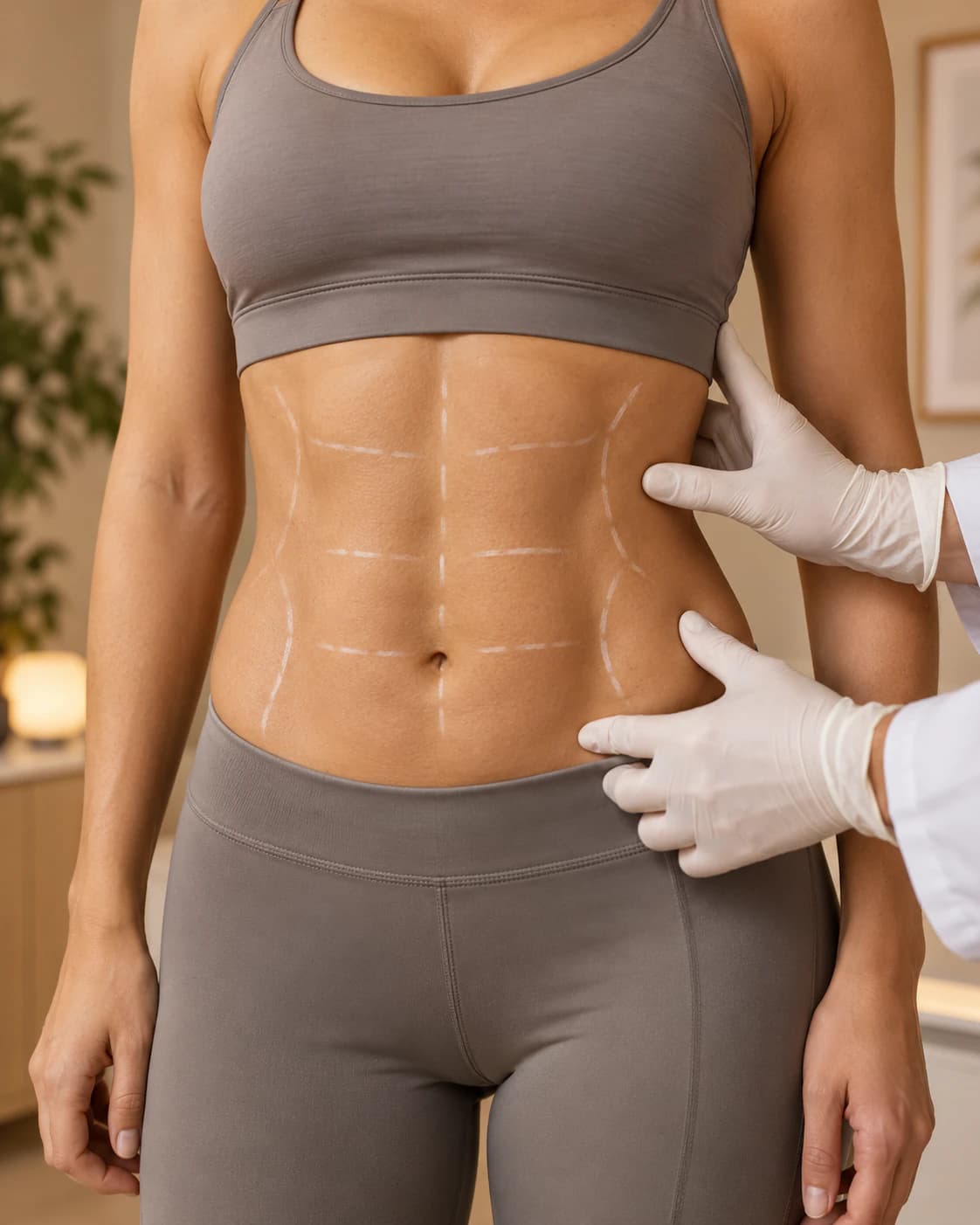
Abdominal etching is a form of high-definition liposuction that selectively removes fat along the natural lines of the abdominal muscles to make them more visible. It requires already-low body fat and existing muscle development to produce a natural result.
Rather than simply reducing abdominal fat, etching removes it selectively — leaving fat over the muscle bellies and taking it from the grooves between them, so the underlying anatomy shows more clearly. The result depends heavily on what is already there. It sculpts around existing muscle; it does not create muscle. In someone with higher body fat or limited abdominal muscle development, the result tends to look unnatural or simply fails to show. Because it is a superficial technique, contour irregularity and visible unevenness are more of a concern than with conventional liposuction, and results can look artificial if weight is later gained.
Published cases for this procedure. Where recorded, each names the surgeon and facility behind it and states how long after surgery the second photograph was taken. Individual outcomes vary — no case is a prediction of your own result.
BeforeAfter
 BeforeAfter
 BeforeAfter
Price varies with the number of areas, the technology used, operating time, anaesthesia, and surgeon experience.
These are variants of the same operation, not a ranking. Which one suits you is a surgical judgement made after examination — the differences below are what that conversation is about.
Ultrasound energy emulsifies fat before removal, which can help with the precision superficial work requires.
A mechanised cannula used for fat removal and contouring.
Harvested fat is sometimes placed over the muscle bellies to enhance definition further.
Medical assessment required: Suitability can only be confirmed by a qualified surgeon who has examined you in person and reviewed your medical history.
Swelling, bruising and soreness. A compression garment is worn continuously; lymphatic massage is often recommended.
Many people are back at desk work. Compression continues; bruising fades.
Gradual return to training as advised.
Swelling fully resolves and definition becomes apparent.
Typical stages, not a schedule you are held to. Healing varies with anatomy, technique and general health, and your surgeon's own aftercare instructions override anything here.
What it cannot do, and where expectations often run ahead.
Etching reveals existing muscle. It does not build muscle, does not remove loose skin, and does not prevent fat returning if weight increases.
Where marks are left, and how they typically settle.
Access incisions are small and usually placed discreetly, but multiple sites are needed for the crossing patterns the technique uses.
| Risk | What it means |
|---|---|
| Bleeding and haematoma | A collection of blood under the skin, occasionally needing a further procedure to drain it. |
| Infection | Usually treated with antibiotics; rarely requires surgical washout. |
| Anaesthetic complications | Risks specific to the anaesthetic used, which the anaesthetist should discuss with you separately. |
| Unsatisfactory aesthetic result | Asymmetry, over- or under-correction, or a result that does not match expectations. May require revision surgery. |
| Contour irregularity | Superficial fat removal makes visible unevenness, ridging or divots more likely than with conventional liposuction. |
| Unnatural appearance | Over-defined or artificial-looking results, particularly if body fat later increases. |
| Skin discolouration or hyperpigmentation | Changes in skin colour over treated areas. |
| Loose skin | Where elasticity is poor, removing fat can leave skin that does not retract. |
| Seroma | Fluid collection that may need drainage. |
| Burns | Where energy-assisted devices are used, thermal injury to skin is possible. |
What applies to every procedure: symptoms that need help now, flying after surgery and insurance.
Conventional liposuction reduces volume without attempting definition and is more forgiving. A tummy tuck may be more appropriate where loose skin is the main issue.
Abdominal etching is a specialised liposuction technique that removes fat selectively along the natural borders of the abdominal muscles to make them look more defined. The surgeon marks the anatomy of the rectus abdominis muscle and the lines around it, then removes fat in a controlled pattern to create shadows and grooves. It is sometimes called six-pack liposuction or abdominal sculpting. The aim is to enhance existing muscle shape, not to create muscles that are not there. Planning is highly individual because each person's muscle pattern and body fat differ.
Good candidates usually already have low body fat, good abdominal muscle tone and firm skin, but still have a thin layer of fat hiding muscle definition. Many are regular exercisers whose weight has been stable for some time. People with higher body fat, significant loose skin, stretch marks or separated abdominal muscles are often better suited to other procedures. Abdominal etching is not intended for weight loss. A surgeon should assess fat thickness, muscle anatomy and skin quality in person before recommending it.
Standard liposuction reduces fat more evenly to create a smoother, slimmer contour, while abdominal etching removes fat selectively to create lines and shadows around the muscles. Etching often involves more superficial and precise work, so there is less margin for error and a greater risk of visible irregularities. Energy-assisted methods such as VASER are sometimes used, but the device does not replace careful planning. Because the result depends on detailed markings and anatomy, the technique is less forgiving than conventional contouring. Compare it with VASER liposuction.
Abdominal etching can look natural when the definition follows your own muscle anatomy and is proportionate to your body fat, but it can look artificial if lines are too deep, too straight or placed incorrectly. Natural abdominal muscles vary in shape and symmetry, and a surgeon should respect those differences. Weight gain can soften the grooves unevenly, while weight loss can make them look more pronounced. Many patients prefer subtle definition that looks consistent with their activity level. Ask to see results from patients with a similar body type.
Yes, exercise and a stable weight remain important after abdominal etching. The procedure highlights muscles that already exist, so the result depends on maintaining both low body fat and muscle tone. If you gain fat, the etched grooves can become less visible or uneven. If you lose significant muscle, the defined areas may look unnatural. Your surgeon will advise when you can gradually return to core training after surgery, because early strenuous exercise may increase swelling or discomfort.
Abdominal etching risks include contour irregularities, asymmetry, unnatural-looking lines, skin dimpling, seroma, bruising, numbness, discolouration and infection. Energy-assisted techniques can also cause burns or heat injury. Because the technique relies on selective fat removal close to the skin, visible irregularities may be more likely than with standard liposuction, and correcting them can be difficult. General liposuction risks, including blood clots and anaesthesia complications, also apply. Ask your surgeon how they plan the markings and how they would manage an uneven result.
Recovery usually involves swelling, bruising and soreness in the abdomen, with many patients returning to desk work within about one to two weeks. A compression garment is commonly worn for several weeks, sometimes with foam pads to support the skin as it settles into the new contours. Walking is encouraged early, while core training and heavy lifting are resumed gradually as advised. Swelling can temporarily hide definition, and the final appearance usually becomes clearer over about three to six months.
Abdominal etching is often combined with liposuction of nearby areas such as the flanks, lower back or chest to create a balanced contour. Treating the waist and back can make the abdomen look more proportionate from different angles. However, combining areas increases operating time, swelling and recovery demands, and surgeons must keep the total fat removal within safe limits. Etching is not usually a substitute for skin removal in someone with loose abdominal skin. Ask how the plan will look from the front, side and back.
Patients are commonly advised to plan around 7–10 days in Turkey after abdominal etching before flying home. This allows a check of the incisions, compression garment fit, swelling and any fluid collection. Wear the garment and pads during travel as instructed, walk during long flights, drink enough water and avoid heavy luggage. Ask for written advice on massage, exercise and garment use, as instructions can vary. Our flying after surgery guide explains how to reduce travel risks.
Abdominal etching cost in Turkey depends on the extent of definition, whether nearby areas such as the flanks, back or chest are treated, the technique or device used, anaesthesia, facility fees and the surgeon's fee. Compression garments, foam pads, drains, medication, follow-up visits and accommodation may not be included. Because etching requires detailed planning and can be difficult to correct, ask how revision surgery would be priced if the definition is uneven. Request an abdominal etching consultation for an individual assessment.
Medical disclaimer
This content is educational and does not constitute medical advice or a diagnosis. It is not a substitute for an individual assessment by an appropriately qualified healthcare professional. Risks, suitability, and outcomes vary by patient. Prices are estimates unless confirmed by a provider's written quotation. Inclusion of any doctor or facility on this site is not a guarantee of outcome. Read the full medical disclaimer.
Why Türkiye
A national authorisation scheme, specialist surgeons and prices set beside those of the countries patients travel from — each with a source you can check.
Hospitals and clinics treating international patients must hold a Ministry of Health health-tourism authorisation and, under the 2025 regulation, must also carry complication insurance for operating-room procedures.
How providers are checkedPlastic, reconstructive and aesthetic surgery is its own specialty in Türkiye, and every profile states the surgeon's title, what we checked and, where we hold it, where they practise.
Meet the surgeonsTürkiye set against the NHS and American Society of Plastic Surgeons figures for the same operation — nothing converted between currencies, every figure dated.
Compare the figures1,949 surgeons and 40 procedures listed, from Istanbul and Ankara to İzmir and Antalya — and a patient team to help you shortlist.
See the hospitals