Dental in Turkey
Dental Implants in Turkey
Compare dentists, costs, treatment options, recovery information and patient results.
A dental implant is an artificial tooth root placed in the jawbone to support a crown, bridge or denture. Treatment often takes several months and two trips to Turkey, and implants need healthy gums, suitable bone and regular maintenance to remain stable.
- Duration
- 30–90 minutes per implant placement visit
- Anaesthesia
- Local anaesthesia (sedation optional)
Last verified
5 August 2026
01
What are Dental Implants?
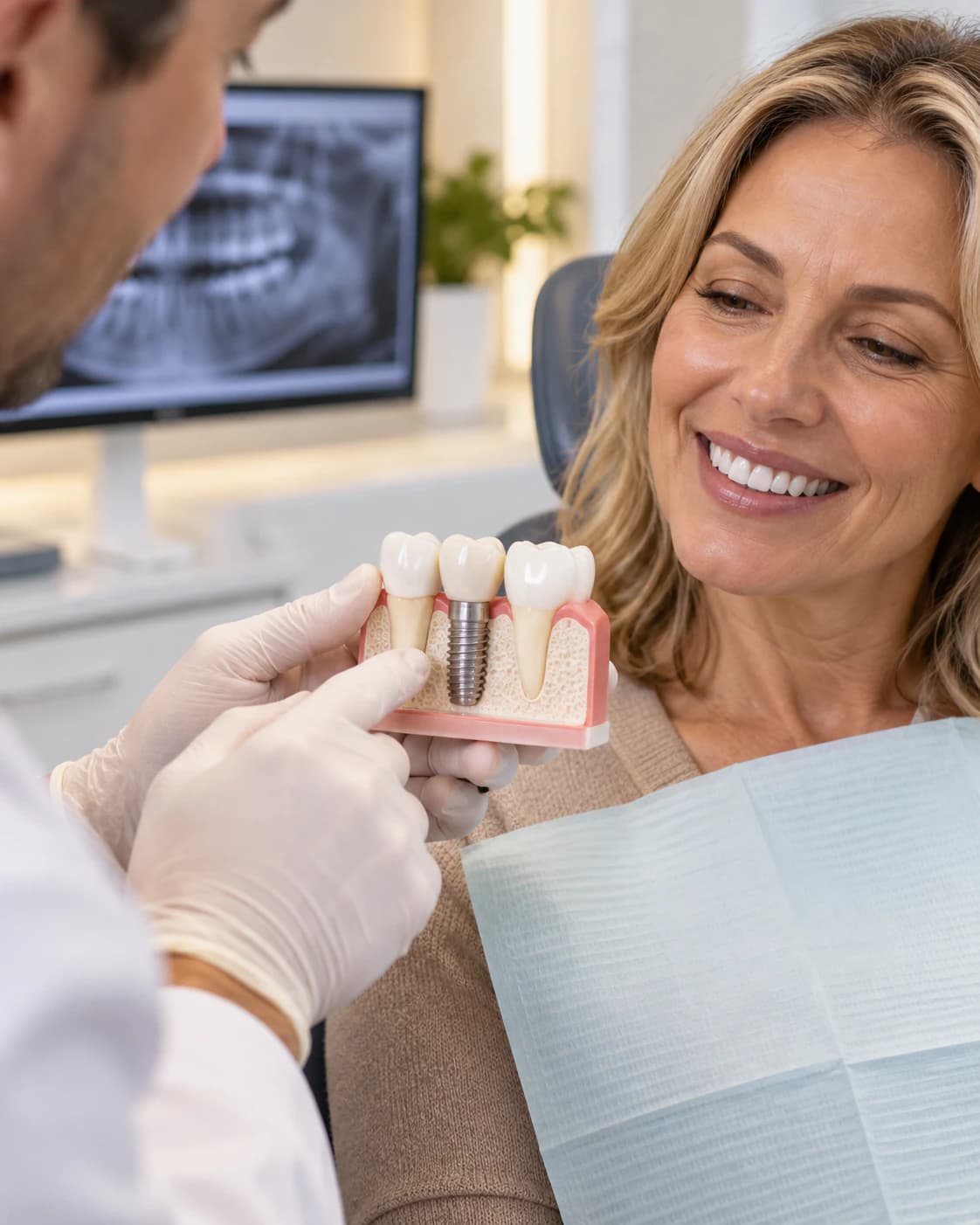
Dental implants are posts, usually made of titanium, that are surgically placed into the jawbone to replace missing tooth roots. A crown, bridge or denture is then attached to the implant, designed to function like a natural tooth. Treatment usually involves two visits. The implant is placed and allowed to integrate with the bone (osseointegration), typically over 3–6 months, before the final crown is attached.
Why patients consider Turkey
Many dental clinics in Turkey, including in Istanbul and Antalya, treat international patients. Clinics use different implant brands and systems, such as Straumann, Nobel Biocare or Osstem, so ask which system is proposed and get written records of it before you leave, because components are not always compatible between systems.
02
Dentists offering Dental Implants
03
Dental Implants — before and after
Published cases for this dental treatment. Where recorded, each names the dentist and facility behind it and states how long after treatment the second photograph was taken. Individual outcomes vary — no case is a prediction of your own result.

 BeforeAfter
 BeforeAfter
 BeforeAfter
04
Cost in Turkey
| City | Price range | Package includes |
|---|---|---|
| Turkey (national) | €700–€1,400 |
Price data last updated 15 September 2026.
Commonly included
- Implant fixture (titanium post)
- Abutment
- Porcelain crown
- Pre-operative X-rays and 3D CT scan
- Local anaesthesia
- Follow-up appointments during your stay in Turkey
05
Types & techniques
These are variants of the same dental treatment, not a ranking. Which one suits you is a clinical judgement your dentist makes after examination — the differences below are what that conversation is about.
Single tooth implant
A single implant fixture with crown to replace one missing tooth.
Multiple implants
Two or more implants to replace multiple missing teeth, either individually or supporting a bridge.
Implant-supported bridge
Two or more implants supporting a bridge to replace multiple adjacent missing teeth.
All-on-4 / All-on-6
Full arch restoration using 4 or 6 implants to support a complete set of teeth. See our dedicated All-on-4 page.
Immediate loading implants
Temporary crown placed on the same day as implant placement. Suitable for selected cases.
Bone grafting
Required when insufficient bone exists for implant placement. Adds time and cost to the treatment.
06
Who may be suitable
May be suitable
- Adults with one or more missing teeth
- Patients with sufficient jawbone density for implant placement
- Non-smokers or those willing to stop during healing
- Patients with good oral hygiene
- Those with realistic expectations about the treatment timeline
May not be suitable
- Patients with uncontrolled diabetes (affects healing)
- Active smokers (smoking significantly increases implant failure risk)
- Those with insufficient bone density (may require grafting first)
- Patients with certain autoimmune conditions
- Those who cannot commit to the full treatment timeline
Medical assessment required: Suitability can only be confirmed by a qualified clinician who has assessed you in person.
07
Recovery timeline
- Stages
- 4
- Begins
- Day of placement (Day 1)
- Final stage
- Final crown placement (second visit)
Day of placement (Day 1)
Stage 1 of 4Mild soreness and swelling after implant placement. Soft diet for 24–48 hours. Day case procedure.
First week (Days 2–7)
Stage 2 of 4Soreness and swelling reduce. Avoid hard foods. Careful oral hygiene around the implant site.
Osseointegration (3–6 months)
Stage 3 of 4The implant integrates with the jawbone. Usually few symptoms during this period. A temporary crown may be worn.
Final crown placement (second visit)
Stage 4 of 4Final crown, bridge, or prosthesis attached once osseointegration is confirmed.
Typical stages, not a schedule you are held to. Healing varies with anatomy, technique and general health, and your dentist's own aftercare instructions override anything here.
08
Risks & complications
| Risk | What it means |
|---|---|
| Your individual risks | All dental procedures carry risks. Discuss the risks specific to your circumstances with your dentist. |
| Implant failure (osseointegration does not occur) | The implant may not bond with the bone or may loosen. Fitting the final restoration before the implant is ready can increase the risk. |
| Infection at the implant site | Infection can occur after placement. Over time, inflammation around the implant (peri-implantitis) can cause bone loss and implant failure. |
| Nerve damage (rare, more common with lower jaw implants) | In the lower jaw, nerve injury can cause numbness or altered sensation in the lip, chin or tongue. |
| Sinus problems (rare, with upper jaw implants near sinuses) | Implants in the upper back jaw lie close to the sinus; where bone is limited, a sinus lift may be needed first. |
| Bone loss around the implant over time | Can result from peri-implantitis. Good oral hygiene, not smoking and regular reviews reduce, but do not eliminate, the risk. |
| Crown or abutment complications | Crowns and screws can chip, loosen or break, and may need repair sooner than the implant itself. |
| Need for bone grafting if insufficient bone | Bone can shrink after tooth loss, gum disease or long-term denture use. Grafting lengthens treatment and increases cost. |
What applies to every procedure: symptoms that need help now, flying after surgery and insurance.
09
Hospitals & clinics offering Dental Implants
10
Frequently asked questions
What is a dental implant?+
A dental implant is an artificial tooth root, usually made from titanium or zirconia, placed into the jawbone to replace a missing tooth. Over time, bone can bond closely with the implant surface, a process called osseointegration. A connector called an abutment is then attached, followed by a crown, bridge or denture. Implants can replace a single tooth, several teeth or support a full arch. They are designed to function like a tooth, but they need healthy gums, suitable bone and regular maintenance to remain stable.
Who is a good candidate for dental implants?+
Good candidates usually have one or more missing teeth, healthy gums, enough jawbone to support an implant or suitability for bone grafting, and good general health. Smoking, uncontrolled diabetes, gum disease, teeth grinding, previous radiotherapy to the jaw and some bone medications can affect healing or long-term success. A dentist typically uses a clinical examination and three-dimensional imaging, such as a CBCT scan, to assess bone volume and nearby nerves or sinuses. You can find dentists who list dental implants and compare their profiles.
How long does dental implant treatment take?+
Dental implant treatment often takes several months from assessment to the final tooth. After the implant is placed, the bone usually needs time to heal and integrate with it before the permanent crown is fitted. Healing periods vary, but a few months is common, and longer may be needed after tooth extraction, bone grafting or a sinus lift. In selected cases, a temporary tooth can be attached soon after placement. Rushing the final restoration before the implant is ready can increase the risk of failure.
Can I get dental implants in one trip to Turkey?+
Dental implants are often completed in two trips to Turkey rather than one. The first visit usually includes assessment, imaging, any extractions and implant placement, sometimes with temporary teeth. The final crown or bridge is often fitted on a second visit after healing. Some cases allow immediate temporary teeth, but permanent teeth on the same trip are not suitable for everyone. Ask for a written treatment timeline, how many days each visit requires, what happens if healing is slower and what temporary solution you will have between trips.
Will I need a bone graft or sinus lift?+
You may need a bone graft or sinus lift if there is not enough bone to hold an implant securely. Bone can shrink after tooth loss, gum disease or long-term denture use. A bone graft adds or rebuilds bone in the jaw, while a sinus lift raises the sinus membrane in the upper back jaw to create space for new bone. These procedures can lengthen treatment and increase cost. A CBCT scan and examination help determine whether grafting is needed or whether shorter, angled or alternative implant options are suitable.
What are the risks of dental implants?+
Dental implant risks include infection, bleeding, swelling, pain, failure of the implant to integrate, loosening, damage to nearby teeth and sinus problems in the upper jaw. In the lower jaw, nerve injury can cause numbness or altered sensation in the lip, chin or tongue. Over time, inflammation around the implant, called peri-implantitis, can cause bone loss and implant failure. Crowns and screws can also chip, loosen or break. Good planning, oral hygiene, stopping smoking and regular reviews reduce but do not eliminate these risks.
How long do dental implants last?+
Dental implants can last many years, but no implant is guaranteed to last for life. Longevity depends on bone and gum health, oral hygiene, smoking, diabetes control, teeth grinding, bite forces and regular professional maintenance. The crown or bridge attached to the implant may need repair or replacement sooner than the implant itself. Peri-implantitis is a common cause of long-term problems and can often be prevented or managed better with early detection. Ask what maintenance schedule is recommended after treatment.
What implant details should I get before leaving Turkey?+
Before leaving Turkey, get written records of the implant brand, system, size, position and the abutment and crown materials used. Ask for copies of X-rays or CBCT scans, treatment notes and any implant card or passport provided. These details help a dentist at home repair or maintain the implant, because components are not always compatible between systems. Also ask what guarantee applies, what it covers, whether you must return to Turkey for repairs and who pays for travel. Our questions before paying worksheet can help.
Who should place my dental implants?+
Dental implants should be planned and placed by a qualified dental professional with implant training, such as a dentist with implant experience, an oral and maxillofacial surgeon, a periodontist or a prosthodontist working as part of a team. Complex cases involving bone grafting, sinus lifts or full-arch treatment may benefit from additional specialist input. Ask who will place the implant, who will fit the final teeth, how many similar cases they treat and whether CBCT imaging will be used. Continuity of care between visits is important.
What affects the cost of dental implants in Turkey?+
Dental implant cost in Turkey depends on the number of implants, implant brand, abutment type, crown or bridge material, imaging, extractions, bone grafting, sinus lifts, temporary teeth and the number of visits. Some quotes include only the implant post, while others include the abutment and final crown. Ask whether travel for a second visit, accommodation and aftercare are included. Also ask how failure or repairs would be handled after you return home. Our dental implant cost page shows recorded ranges.
11
References
- [1]Dental Implants — American Dental Association patient information — American Dental Association (ADA)
Medical disclaimer
This content is educational and does not constitute medical advice or a diagnosis. It is not a substitute for an individual assessment by an appropriately qualified healthcare professional. Risks, suitability, and outcomes vary by patient. Prices are estimates unless confirmed by a provider's written quotation. Inclusion of any doctor or facility on this site is not a guarantee of outcome. Read the full medical disclaimer.
Why Türkiye
What Türkiye offers, and how to check it
A national authorisation scheme, specialist surgeons and prices set beside those of the countries patients travel from — each with a source you can check.
A national authorisation scheme
Hospitals and clinics treating international patients must hold a Ministry of Health health-tourism authorisation and, under the 2025 regulation, must also carry complication insurance for operating-room procedures.
How providers are checked1,935 plastic surgery specialists
Plastic, reconstructive and aesthetic surgery is its own specialty in Türkiye, and every profile states the surgeon's title, what we checked and, where we hold it, where they practise.
Meet the surgeonsPrices you can compare in the open
Türkiye set against the NHS and American Society of Plastic Surgeons figures for the same operation — nothing converted between currencies, every figure dated.
Compare the figures845 hospitals and clinics, 70 cities
1,949 surgeons and 40 procedures listed, from Istanbul and Ankara to İzmir and Antalya — and a patient team to help you shortlist.
See the hospitals