Secondary nose surgery · Planning guide for international patients
Revision Rhinoplasty in Turkey
Revision rhinoplasty corrects breathing or shape problems after a previous nose operation. Why it is more complex, when grafts are needed, what the evidence says about further revision and what it costs in Turkey.
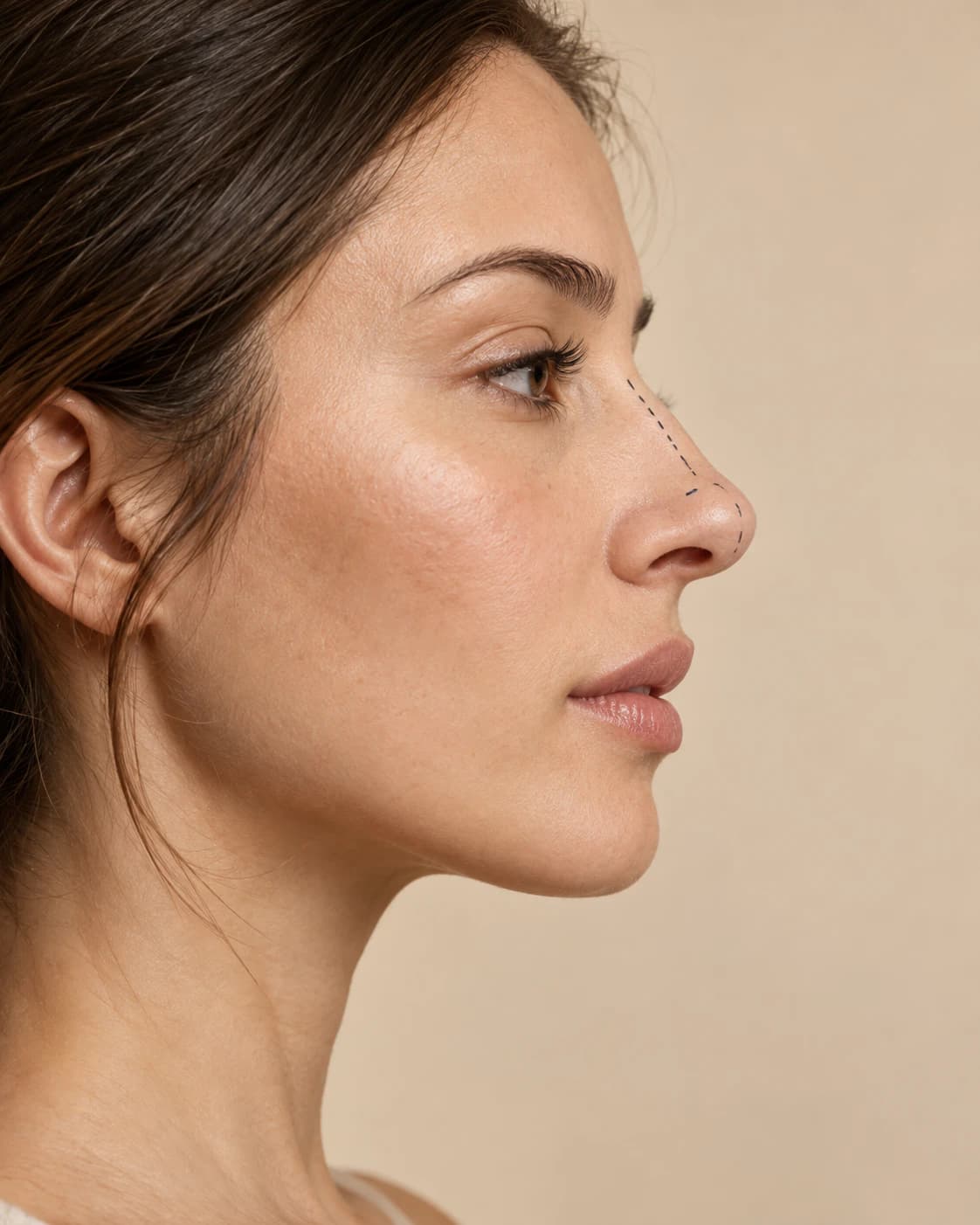
- Hospital stay
- 1–2 nights
- Recommended Turkey stay
- 10–14 days
- Initial recovery
- 10–14 days
- Final result
- 18–24 months
Revision rhinoplasty — also called secondary rhinoplasty — is surgery on a nose that has already been operated on. Patients seek it because the shape did not turn out as planned, because breathing became worse, or both.
It is a different undertaking from a first rhinoplasty. Scar tissue replaces normal tissue planes, cartilage that would normally be used for support may already have been removed, and the skin may be thinner or thicker and less forgiving. Many revisions need cartilage from the ear or rib. For patients travelling to Turkey, this makes surgeon selection, realistic goals and the records you send beforehand more important than with any first-time nose operation. If you have not had nose surgery before, see the rhinoplasty in Turkey guide instead.
01
Why Revision Is More Complex
In a study comparing 153 first-time and 92 revision rhinoplasties at a specialist facial plastic surgery clinic, almost two-thirds of revision patients had both breathing and appearance problems. Complex reconstructive techniques, removing and rebuilding the septum outside the nose, and grafts taken from outside the nose were all used more often in revision cases.
The authors advised that patients be told about the added complexity, the possible need for grafts from outside the nose, and a higher risk of needing yet another operation.
02
Minor Revision or Full Reconstruction?
A review of revision cases classified secondary surgery broadly into minor revisions — often correcting one area — and complete redo operations. The distinction affects approach, grafts, operating time and price.
| Minor revision | Full revision | |
|---|---|---|
| Typical problems | A small residual hump, tip asymmetry, a nostril irregularity | Collapsed middle vault, over-reduced or twisted nose, major breathing obstruction |
| Approach | Sometimes closed, through incisions inside the nostrils | Usually open, with a small scar across the skin between the nostrils |
| Grafts | Often none, or small septal or ear grafts | Often ear or rib cartilage |
| Operating time and recovery | Shorter | Longer, with more swelling |
03
Cartilage Grafts: Septum, Ear and Rib
A first rhinoplasty often uses cartilage from the septum. If that was removed or used previously, the surgeon may need another source:
| Graft source | Typical use | Considerations |
|---|---|---|
| Remaining septal cartilage | Small structural or tip grafts | May be insufficient after previous surgery |
| Ear cartilage | Tip and nostril support, small contour grafts | Curved and softer; a small scar behind or in the ear |
| Your own rib cartilage | Major structural rebuilding, dorsum and septum support | Chest scar; donor-site effects |
| Donor (processed) rib cartilage | An alternative to taking your own rib | Ask about sourcing, processing and resorption |
A 2023 meta-analysis of 1,648 patients receiving their own rib cartilage in rhinoplasty reported warping in about 3%, resorption in 1.2%, infection in 1.5% and contour irregularity in 1.5%, with a revision rate of 2.3%. At the donor site, a thickened chest scar occurred in about 2%, and no pneumothorax was recorded across the pooled studies. Including both sites, the pooled overall complication rate was about 15%.
04
When to Consider Revision
After nose surgery, swelling settles gradually: the NHS notes that it can take up to six months to go completely after rhinoplasty. Revision is usually planned once the nose has healed and the shape has stabilised. A surgeon who offers to operate very soon after a previous rhinoplasty, without a clear medical reason, should explain why.
Ask your surgeon when they consider your nose ready, and whether any concern could still improve without surgery.
05
Setting Realistic Goals
- Breathing first. Functional problems are assessed alongside appearance; a nose that looks better but breathes poorly is not a successful revision.
- Improvement, not perfection. Scar tissue and skin quality limit what can be refined.
- Further surgery is possible. In the comparative study above, another revision was needed in 23.9% of revision patients during follow-up, compared with 10.5% after first rhinoplasty. A separate surgeon's series reported re-revision rates of 15.7% and 9% in two different practice settings.
06
Revision Rhinoplasty Cost in Turkey
In September 2026, advertised starting prices for revision rhinoplasty from Turkish surgeons and clinics were commonly around €3,500–€5,000, with standard revisions often quoted at about €3,800–€6,000 and complex reconstructions using rib cartilage from about €6,000 upwards. Prices are more individual than for first-time rhinoplasty; a firm quote normally follows review of photographs, records and examination.
| Cost factor | Why it may change the price | What to confirm |
|---|---|---|
| Scope of revision | Full reconstruction takes much longer than a minor correction | Minor or full revision |
| Graft source | Rib harvesting or donor cartilage adds time and materials | Ear, own rib or donor rib |
| Breathing work | Septum and airway reconstruction | Functional work included |
| Imaging | CT scans may be requested for airway assessment | Whether imaging is needed and included |
| Hospital stay | One or two nights are common | Nights included |
| Aftercare | Splint removal, taping and follow-up | Visits included and remote follow-up |
| Travel services | Around ten days to two weeks of accommodation | Nights included and extra-night price |
07
What to Check in Your Revision Rhinoplasty Quote
- the problems the surgeon plans to correct, in writing
- open or closed approach, and graft sources including rib
- whether breathing will be assessed and treated
- the operating surgeon and anaesthetist
- hospital nights, splint removal and follow-up schedule
- policy and cost if a further revision is needed
08
Surgeons Offering Revision Rhinoplasty in Turkey
These surgeons list revision rhinoplasty on their own website, a hospital staff page or our register. Order reflects profile completeness, not merit.

09
Choosing a Surgeon for Revision Rhinoplasty
Revision rhinoplasty is performed by plastic surgeons and by ear, nose and throat surgeons with facial plastic surgery training. Look for:
- Regular revision work, not only first-time rhinoplasty
- Experience with rib cartilage, if your nose may need structural rebuilding
- A diagnosis before a design: the surgeon should explain what went wrong structurally, not just show a digital simulation
- Breathing assessment as part of the consultation
- Revision case photographs taken at least a year after surgery, with side and base views
- Candour about limits, including when a further operation would not be advisable
10
Choosing a Hospital for Revision Rhinoplasty
Revision rhinoplasty is performed under general anaesthesia, and longer reconstructions — especially with rib grafts — need a hospital with an anaesthetist and overnight care. The NHS notes a stay of one or two nights is likely after nose reshaping. Facilities treating international patients should hold a health tourism authorisation and appear on the HealthTürkiye certified provider list.
11
Before-and-After Photos
Ask specifically for revision cases, not first-time rhinoplasty results. Compare front, both side, three-quarter and base views taken in the same lighting and at least a year after surgery. Look for a straight, well-supported nose rather than an over-refined tip, and ask how breathing changed.
12
Recovery After Revision Rhinoplasty
| Period | What is typical | What to plan |
|---|---|---|
| First week | Splint, swelling, bruising, blocked nose; chest soreness if rib was used | Rest with head raised; no nose blowing |
| Around one week | Splint and external stitches removed | Stay for this review before flying |
| Weeks two to six | Bruising settles; swelling persists | Avoid glasses resting on the nose and contact sports, as advised |
| Following months | Swelling continues to settle and the shape refines | Photograph progress and share it with your surgeon |
13
Risks and Safety Considerations
Revision rhinoplasty carries the risks of any nose surgery — bleeding, infection, breathing obstruction, asymmetry, numbness and dissatisfaction with the shape — together with risks specific to secondary surgery: skin healing problems over scarred tissue, graft warping, resorption or visibility, donor-site problems if ear or rib cartilage is used, and a higher chance of needing further surgery.
14
How Long to Stay in Turkey
Patients commonly plan around 10–14 days in Turkey after revision rhinoplasty, so that the splint and stitches can be removed and early healing checked. If rib cartilage is harvested, allow for chest discomfort when lifting luggage. Your surgeon confirms when you can fly.
15
What to Send for a Preliminary Assessment
- operative notes from previous nose surgery, if you can obtain them
- photographs from before your first operation, if available
- current photographs: front, both sides, both three-quarter views and the base of the nose, in daylight, neutral expression
- a description of breathing problems, and any CT scans or ENT reports
- medical conditions, medication and smoking status
These records help a surgeon judge whether revision is feasible and what grafts may be needed. The plan is confirmed only after examination.
16
Revision Rhinoplasty in Istanbul and Other Cities
Most surgeons listing revision rhinoplasty on our register practise in Istanbul, with a smaller number in Ankara.
17
Request Revision Rhinoplasty Options
Send your surgical history, records and photographs to receive revision rhinoplasty options you can compare. A request is not a booking; whether and how to operate is decided only after examination by the surgeon who will operate.
18
Frequently asked questions
What is revision rhinoplasty?+
Revision rhinoplasty, also called secondary rhinoplasty, is surgery to correct the appearance or function of a nose that has already been operated on. It ranges from a small refinement, such as smoothing a residual bump, to major reconstruction of a nose whose support has collapsed. Patients seek it for cosmetic concerns, breathing problems that began or persisted after surgery, or both. Because the nose has been altered before, the surgeon works with scar tissue and a changed framework, so the planning is more involved than for a first operation and the goals need to be discussed especially carefully.
How long should I wait before having revision rhinoplasty?+
Many surgeons recommend waiting at least a year after the previous rhinoplasty before revision, and sometimes longer. Swelling, particularly in the nasal tip, can take 12 months or more to settle, and scar tissue needs time to soften; operating too early can make it hard to judge the true result or plan corrections accurately. An earlier operation may be considered for significant breathing obstruction or other functional problems, but only after specialist assessment. If you are unhappy with your nose soon after surgery, a review with your original surgeon is a reasonable first step while tissues mature.
Why is revision rhinoplasty more complex than a first rhinoplasty?+
Revision rhinoplasty is more complex because the surgeon operates on tissue that has already been changed. Scar tissue makes structures harder to identify, cartilage may have been removed or weakened, the skin can be thinner or less elastic, and blood supply may be altered. The surgeon often cannot know exactly what was done before, which is why previous operation notes are valuable. Rebuilding lost support frequently requires cartilage grafts. For these reasons, open rhinoplasty is commonly used for revisions, operations tend to take longer, and results can be more limited than in a first rhinoplasty.
What problems can revision rhinoplasty correct?+
Revision rhinoplasty can address problems such as a residual or new hump, a scooped or collapsed bridge (saddle nose), a pinched or asymmetric tip, a fullness above the tip known as a pollybeak, a nose that is too short or upturned, visible irregularities, and breathing obstruction from collapsed nasal valves or a remaining septal deviation. Some changes are more achievable than others: tight, scarred skin limits how much the nose can be lengthened or refined. A surgeon experienced in secondary cases should explain which of your concerns can realistically be improved and which may only be partly corrected.
Will I need cartilage grafts from my ear or rib?+
Many revision rhinoplasties need cartilage grafts, because septal cartilage, the usual first choice, is often depleted by the earlier operation. When septal cartilage is insufficient, surgeons may use ear cartilage, which is curved and suits smaller tip grafts, or rib cartilage, which provides more strength and volume for rebuilding the bridge or supporting a collapsed nose. Rib cartilage can come from your own rib or, in some practices, from processed donor tissue. Each option has trade-offs, including donor-site discomfort and the risk of warping, so the choice is made after examination.
How long should I stay in Turkey after revision rhinoplasty?+
Revision rhinoplasty patients are commonly advised to plan around 10–14 days in Turkey, which is longer than for a first rhinoplasty. The extra time allows for splint removal, a wound check, and review of any graft donor site before flying. A hospital stay of one to two nights is typical. Swelling after revision often lasts longer, and the final result may take 18–24 months to show. Before travelling home, confirm who will review your progress in the months ahead and how photographs or video check-ins will be handled. See our advice on flying home after surgery.
What results can I realistically expect from revision rhinoplasty?+
A realistic goal for revision rhinoplasty is meaningful improvement, not a perfect nose. Scar tissue, skin quality and the amount of cartilage available all limit what can be achieved, and complex cases can take longer to settle than first operations. Many patients see better symmetry, stronger support or improved breathing, but subtle irregularities may remain. Swelling persists longer after revision, so early appearance is not the final result. Surgeons generally discuss priorities with patients, focusing on the concerns that matter most, because trying to correct every detail in heavily scarred tissue can increase risk.
What are the risks of revision rhinoplasty?+
Revision rhinoplasty carries the risks of any rhinoplasty, including bleeding, infection, asymmetry, breathing changes and dissatisfaction, with some risks that are more relevant in secondary surgery. These include prolonged swelling, compromised skin healing where tissue is thin or scarred, graft warping, shifting or resorption, and discomfort or scarring at a rib or ear donor site. There is also a possibility that a further operation may be needed. Your individual risk depends on how many operations you have had and what needs correcting, so ask your surgeon to explain this for your case.
How do I choose a revision rhinoplasty surgeon in Turkey?+
Look for a surgeon who regularly performs secondary rhinoplasty, not just primary operations, and who can show revision results from patients with problems similar to yours. Ask how they rebuild support, which graft sources they use, and how they assess breathing. Bring your previous operation notes, photos from before your first surgery, and any imaging you have, as these help with planning. Remote photo review can be a useful first step, but a revision plan should be confirmed after an in-person nasal examination. You can compare surgeons listing revision rhinoplasty.
What affects the cost of revision rhinoplasty in Turkey?+
Revision rhinoplasty usually costs more than a first rhinoplasty because it takes longer and often involves grafting. The main factors are the extent of reconstruction, whether ear or rib cartilage is harvested, operating time, the surgeon's fee, the hospital and anaesthesia, and the number of hospital nights. Check whether pre-operative tests, splints, medication, follow-up visits and a longer stay in Turkey are included. Because revision plans vary widely, a price given before examination should be treated as provisional. Our revision rhinoplasty cost page shows recorded ranges.
19
Medical references
- [1]Certified health service providers (international health tourism) — HealthTürkiye — Ministry of Health / USHAŞ
- [2]Nose reshaping (rhinoplasty) — NHS
- [3]Differences between Primary and Revision Rhinoplasty: Indications, Techniques, Grafts, and Outcomes — Hacker S et al., Plastic and Reconstructive Surgery, 2021
- [4]Revision Rhinoplasty: What Can We Learn from Error Patterns? An Analysis of Revision Surgery — East C et al., Facial Plastic Surgery, 2016
- [5]Complications Associated with Autologous Costal Cartilage Used in Rhinoplasty: An Updated Meta-Analysis — Chen H et al., Aesthetic Plastic Surgery, 2023
Medical disclaimer
This content is educational and does not constitute medical advice or a diagnosis. It is not a substitute for an individual assessment by an appropriately qualified healthcare professional. Risks, suitability, and outcomes vary by patient. Prices are estimates unless confirmed by a provider's written quotation. Inclusion of any doctor or facility on this site is not a guarantee of outcome. Read the full medical disclaimer.
Why Türkiye
What Türkiye offers, and how to check it
A national authorisation scheme, specialist surgeons and prices set beside those of the countries patients travel from — each with a source you can check.
A national authorisation scheme
Hospitals and clinics treating international patients must hold a Ministry of Health health-tourism authorisation and, under the 2025 regulation, must also carry complication insurance for operating-room procedures.
How providers are checked1,935 plastic surgery specialists
Plastic, reconstructive and aesthetic surgery is its own specialty in Türkiye, and every profile states the surgeon's title, what we checked and, where we hold it, where they practise.
Meet the surgeonsPrices you can compare in the open
Türkiye set against the NHS and American Society of Plastic Surgeons figures for the same operation — nothing converted between currencies, every figure dated.
Compare the figures845 hospitals and clinics, 70 cities
1,949 surgeons and 40 procedures listed, from Istanbul and Ankara to İzmir and Antalya — and a patient team to help you shortlist.
See the hospitals