Hair Transplant in Turkey
FUE Hair Transplant in Turkey
Compare surgeons, costs, treatment options, recovery information and patient results.
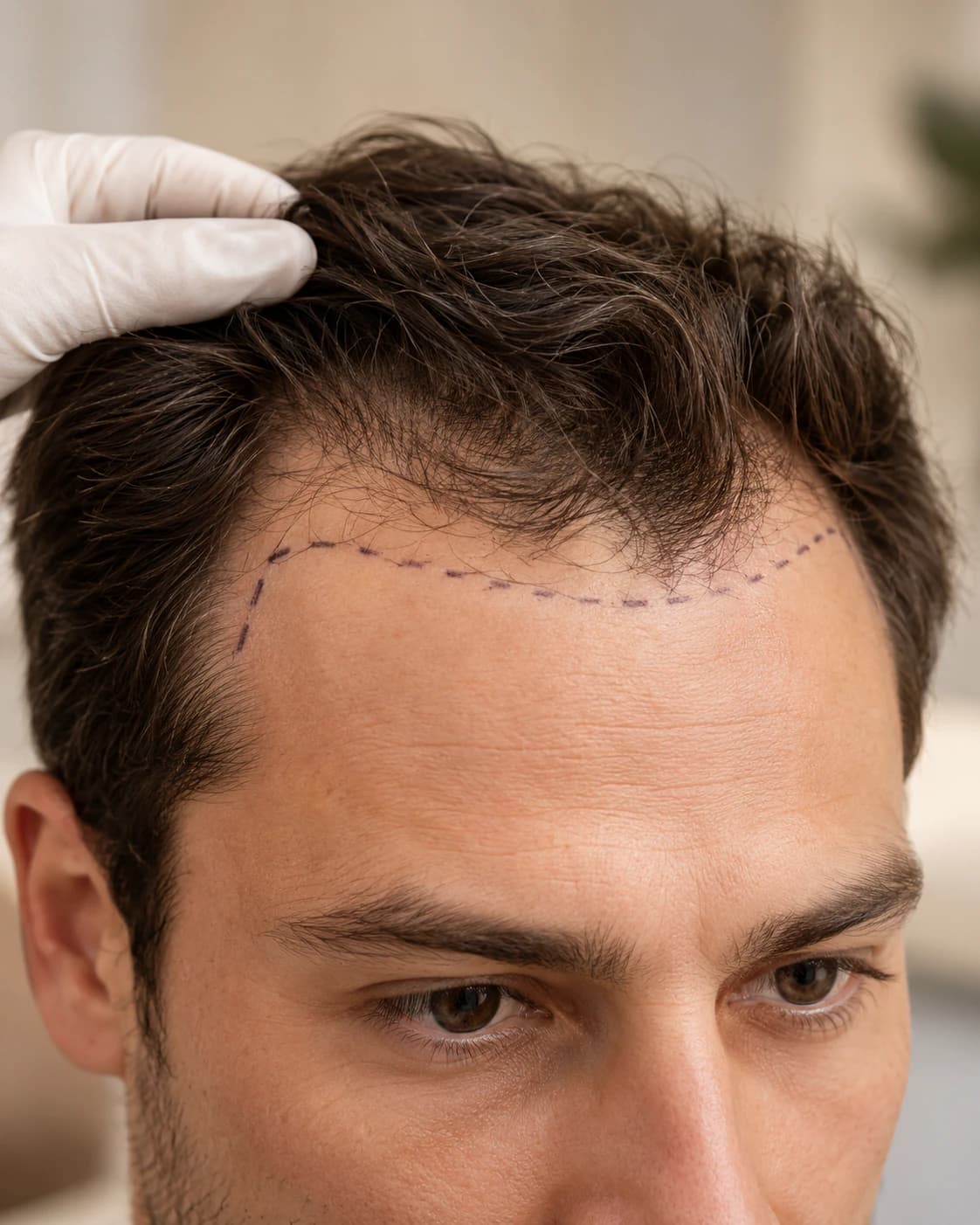
FUE (follicular unit extraction) is a hair transplant technique that moves individual follicular units from a donor area, usually the back and sides of the scalp, to thinning or bald areas. It avoids the linear scar of strip harvesting but leaves many small dot-like scars, and it does not stop future hair loss.
- Duration
- 6–8 hours (single session, varies by graft count)
- Anaesthesia
- Local anaesthesia, often with sedation available
- Hospital stay
- Day case
- Final result
- 12–18 months
Last verified
5 August 2026
01
What is FUE Hair Transplant?
Follicular Unit Extraction (FUE) is a widely used hair transplant technique. Individual follicular units — each containing 1–4 hairs — are extracted from the donor area using a micro-punch tool (typically 0.6–0.9 mm in diameter) and transplanted to areas of thinning or baldness. FUE leaves no linear scar, which allows many patients to wear their hair short, although it does leave many small dot-like scars. The procedure is performed under local anaesthesia and takes 6–8 hours for a typical session. Most patients return to normal activity within 7–10 days.
Why patients consider Turkey
Many clinics in Turkey, particularly in Istanbul, offer hair transplants to international patients, often as packages that may include accommodation and transfers. Packages differ in what they include and in who performs each step, so compare itemised quotes and confirm the doctor's role before booking.
02
Surgeons offering FUE Hair Transplant
03
Cost in Turkey
| City | Price range | Package includes |
|---|---|---|
| Turkey (national) | €2,000–€5,000 |
Price data last updated 15 September 2026.
Commonly included
- Grafts (the number agreed in your treatment plan)
- Surgeon and technician fees
- Pre-operative assessment
- Post-operative medications and shampoo
- Hotel accommodation (some packages)
- Airport transfer (some packages)
04
Types & techniques
These are variants of the same operation, not a ranking. Which one suits you is a surgical judgement made after examination — the differences below are what that conversation is about.
Standard FUE
Manual or motorised micro-punch extraction of follicular units, followed by creation of recipient sites and implantation.
Sapphire FUE
Recipient sites created with sapphire-tipped blades rather than steel, potentially allowing denser placement and faster healing.
Robotic FUE (ARTAS)
AI-assisted robotic extraction intended to give consistent graft quality. Less common in Turkey, but offered at some clinics.
Mega session FUE
Large sessions of 4,000+ grafts performed in a single day for patients with extensive hair loss.
05
Who may be suitable
May be suitable
- Adults with stable androgenetic alopecia (male or female pattern baldness)
- Patients with sufficient donor hair density
- Those who want to wear their hair short (no linear scar)
- Non-smokers or those willing to stop for 2+ weeks
- Patients with realistic expectations
May not be suitable
- Patients with actively progressing hair loss
- Those with insufficient donor density
- Patients with scarring alopecia or alopecia areata
- Those with unrealistic expectations about full coverage
Medical assessment required: Suitability can only be confirmed by a qualified clinician who has assessed you in person.
06
Recovery timeline
- Stages
- 5
- Begins
- Day of procedure (Day 1)
- Final stage
- Final result (12–18 months)
Day of procedure (Day 1)
Stage 1 of 56–8 hour procedure under local anaesthesia. Mild soreness. Return to hotel same day.
Days 2–10
Stage 2 of 5Scabs form. Gentle washing from day 3. Avoid touching grafts. Avoid sun, swimming, and exercise.
Shedding (Weeks 2–8)
Stage 3 of 5Transplanted hairs commonly shed. This is normal and expected, as the follicles remain in the scalp.
Regrowth (Months 3–6)
Stage 4 of 5New hair grows from transplanted follicles. Initially fine, gradually thickens.
Final result (12–18 months)
Stage 5 of 5Hair continues to thicken and mature, and the final result is usually assessed at this stage. Results vary between patients.
Typical stages, not a schedule you are held to. Healing varies with anatomy, technique and general health, and your surgeon's own aftercare instructions override anything here.
07
Risks & complications
| Risk | What it means |
|---|---|
| Your individual risks | All procedures carry risks. Discuss the risks specific to your circumstances with your clinic. |
| Shock loss (temporary shedding) | Some existing hair near the transplanted area may shed temporarily after the procedure. |
| Poor graft survival | Some transplanted grafts may not grow. Outcomes depend on assessment, donor management, graft handling and implantation. |
| Infection | Infection of the donor or recipient area. Folliculitis (inflamed hair follicles) and cysts can also occur. |
| Scarring in the donor area | FUE leaves many small dot-like scars rather than a linear scar. Overharvesting can leave the donor area visibly thin or patchy. |
| Unnatural hairline | Poor planning can produce a hairline that looks unnatural, particularly if hair behind it continues to thin. |
| Numbness (usually temporary) | Reduced feeling in the treated areas of the scalp. |
| Unsatisfactory density | Final density depends mainly on donor supply, graft survival and hair characteristics, and may be less than hoped for. |
What applies to every procedure: symptoms that need help now, flying after surgery and insurance.
08
Hospitals & clinics offering FUE Hair Transplant
09
Frequently asked questions
What is FUE hair transplant?+
FUE, or follicular unit extraction, is a hair transplant technique in which individual follicular units are removed from a donor area, usually the back and sides of the scalp. Each graft may contain one or more hairs. The grafts are then placed into small recipient sites created in thinning or bald areas. FUE avoids the long linear donor scar associated with strip harvesting, although it leaves many small dot-like scars. The procedure moves existing hair from one area to another; it does not create new hair follicles or stop future hair loss.
Who is a good candidate for FUE hair transplant?+
Good candidates usually have pattern hair loss, enough healthy donor hair and realistic expectations about density and future loss. The cause of hair loss should be diagnosed first, because conditions such as alopecia areata, thyroid disease, iron deficiency or scarring alopecias may need different treatment. Very young patients may still have unpredictable hair loss, so planning must consider how the pattern could progress. Women with diffuse thinning need careful evaluation. A specialist should examine donor density, hair quality and the extent of loss.
How many grafts will I need for an FUE hair transplant?+
The number of grafts depends on the size of the area being treated, the density you hope to achieve, your donor supply and hair characteristics such as thickness, curl and colour contrast with the scalp. Donor hair is limited, so the aim is to use it carefully over your lifetime rather than extract as many grafts as possible at once. Overharvesting can leave the donor area visibly thin. Be cautious if a very high graft number is promised before your donor area has been examined. Ask how the number was calculated.
What is the difference between FUE, FUT and DHI hair transplants?+
FUE removes individual grafts from the donor area, while FUT removes a strip of scalp that is divided into grafts, leaving a linear scar. DHI usually refers to an implantation method in which grafts are placed with a pen-like implanter rather than into pre-made channels; extraction is often performed using FUE. Each approach has advantages and limitations depending on donor quality, the area treated, shaving preference and surgeon experience. No technique is best for everyone. Compare the implantation method in our DHI hair transplant guide.
How is the new hairline designed?+
A hairline should be designed for your age, face shape, current hair loss and likely future hair loss. A very low or dense hairline may look good initially but can appear unnatural later if hair behind it continues to thin and donor hair is insufficient to maintain balance. Natural hairlines are usually irregular rather than perfectly straight, with finer single-hair grafts at the front. Your temples, forehead proportions and ethnicity also matter. Ask to see the proposed hairline drawn before surgery and discuss how it will look in future years.
When will I see results after an FUE hair transplant?+
Transplanted hairs commonly shed during the first weeks after surgery, which is normal because the follicles remain in the scalp. New growth often begins around three to four months, with more visible change around six months. Hair continues to thicken and mature, and the final result is usually assessed around 12–18 months. Some existing hair near the transplanted area may also shed temporarily, known as shock loss. Progress varies between patients. Taking consistent photographs can help you compare changes over time.
Do I still need hair loss medication after a transplant?+
A hair transplant does not stop native hair from continuing to thin, so some patients are advised to consider medical treatment to help protect existing hair. Options may include minoxidil or, for some men, finasteride, but they are not suitable for everyone and can have side effects. Women need specific advice, especially if pregnancy is possible. The decision should be made with a qualified doctor who knows your medical history. Without treatment, future loss around the transplanted area may create an uneven appearance and require further procedures.
What are the risks of FUE hair transplant?+
FUE risks include infection, bleeding, swelling, numbness, folliculitis, cysts, poor graft growth, visible donor scarring and shock loss of existing hair. Overharvesting can leave the donor area patchy or thin, and poor planning can create an unnatural hairline or insufficient density. Outcomes depend on medical assessment, donor management, graft handling and implantation. Ask who performs the extraction, who creates recipient sites and who places grafts, because some tasks may be delegated to team members. See our clinic red flags guide before choosing where to go.
How long should I stay in Turkey after an FUE hair transplant?+
Many patients stay a few days in Turkey after an FUE hair transplant, often allowing time for the procedure, a check the next day and instructions on the first wash. Your exact stay should be based on the clinic's aftercare plan and your health. During travel, avoid bumping or rubbing the recipient area, follow advice on hats and pillows, and keep medication and aftercare products in hand luggage. Ask for written washing instructions and how photographs will be reviewed after you return home. Our flying after surgery guide covers travel precautions.
What affects the cost of an FUE hair transplant in Turkey?+
FUE hair transplant cost in Turkey depends on the number of grafts, the size of the treated area, the technique, the doctor's involvement, the clinic or hospital, anaesthesia and aftercare. Some packages include accommodation, transfers, medication and washing products, while others do not. Treatments added to the package, such as platelet-rich plasma, should be explained separately. Compare what each quote includes and who performs each step, not only the price per graft. See our FUE hair transplant cost page for recorded ranges.
10
References
- [1]Hair Restoration Basics — International Society of Hair Restoration Surgery — International Society of Hair Restoration Surgery (ISHRS)
Medical disclaimer
This content is educational and does not constitute medical advice or a diagnosis. It is not a substitute for an individual assessment by an appropriately qualified healthcare professional. Risks, suitability, and outcomes vary by patient. Prices are estimates unless confirmed by a provider's written quotation. Inclusion of any doctor or facility on this site is not a guarantee of outcome. Read the full medical disclaimer.
Why Türkiye
What Türkiye offers, and how to check it
A national authorisation scheme, specialist surgeons and prices set beside those of the countries patients travel from — each with a source you can check.
A national authorisation scheme
Hospitals and clinics treating international patients must hold a Ministry of Health health-tourism authorisation and, under the 2025 regulation, must also carry complication insurance for operating-room procedures.
How providers are checked1,935 plastic surgery specialists
Plastic, reconstructive and aesthetic surgery is its own specialty in Türkiye, and every profile states the surgeon's title, what we checked and, where we hold it, where they practise.
Meet the surgeonsPrices you can compare in the open
Türkiye set against the NHS and American Society of Plastic Surgeons figures for the same operation — nothing converted between currencies, every figure dated.
Compare the figures845 hospitals and clinics, 70 cities
1,949 surgeons and 40 procedures listed, from Istanbul and Ankara to İzmir and Antalya — and a patient team to help you shortlist.
See the hospitals