Hair Transplant in Turkey
DHI Hair Transplant in Turkey
Compare surgeons, costs, treatment options, recovery information and patient results.
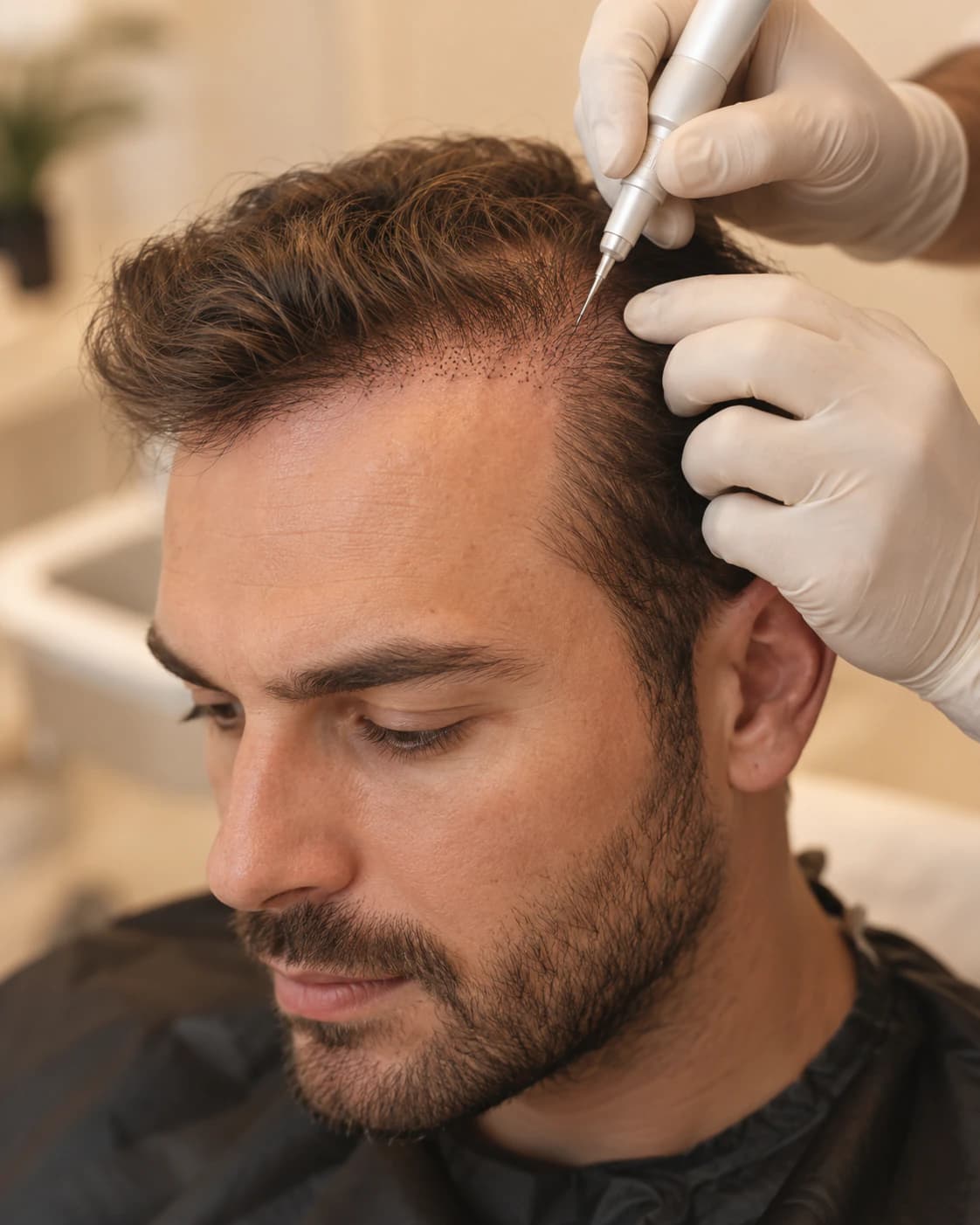
DHI (direct hair implantation) is a hair transplant approach in which grafts, usually extracted as in FUE, are placed with a pen-like implanter (Choi pen) that creates the site and inserts the graft in one step. It can be useful for placing grafts among existing hair, but evidence that it consistently gives better results than other methods is limited.
- Hospital stay
- Day case
- Final result
- 12–18 months
01
What is DHI Hair Transplant?
Direct Hair Implantation (DHI) is a variation of FUE in which follicular units are implanted directly into the recipient area using a specialised tool called a Choi implanter pen, without first creating recipient site incisions. This may allow more control over the depth, angle and direction of each implanted hair. DHI can be useful for adding density to areas where hair is still present, because grafts can be placed between existing hairs. It is also used for hairline design, where precise placement matters.
Why patients consider Turkey
Many clinics in Turkey offer DHI to international patients. Compared with standard FUE, the technique requires implanter pens and additional training and can take longer, so it may be priced differently. Compare itemised quotes and ask who performs each step.
02
Surgeons offering DHI Hair Transplant
03
Cost in Turkey
| City | Price range | Package includes |
|---|---|---|
| Turkey (national) | €3,400–€5,000 |
Price data last updated 15 September 2026.
Commonly included
- Grafts (the number agreed in your treatment plan)
- Choi pen equipment
- Surgeon and technician fees
- Pre-operative assessment
- Post-operative medications and shampoo
- Hotel accommodation (some packages)
- Airport transfer (some packages)
04
Types & techniques
These are variants of the same operation, not a ranking. Which one suits you is a surgical judgement made after examination — the differences below are what that conversation is about.
Standard DHI
Follicular units extracted by FUE and immediately implanted with a Choi pen, without pre-made recipient sites.
DHI combined with sapphire FUE
Some clinics combine the two methods in one session, opening channels with sapphire blades in some areas and using implanter pens in others. Evidence that one method consistently gives better results is limited.
DHI for density
Used to add density to thinning areas that still have hair, where the implanter can place grafts between existing hairs, which may reduce trauma to surrounding follicles.
05
Who may be suitable
May be suitable
- Patients seeking to add density to areas with existing thinning hair
- Those requiring precise hairline design
- Adults with stable hair loss and sufficient donor density
- Non-smokers or those willing to stop for 2+ weeks
- Patients with realistic expectations
May not be suitable
- Patients with very extensive baldness (FUE may be more efficient for large areas)
- Those with insufficient donor density
- Patients with actively progressing hair loss
- Those with unrealistic expectations
Medical assessment required: Suitability can only be confirmed by a qualified clinician who has assessed you in person.
06
Recovery timeline
- Stages
- 5
- Begins
- Day of procedure (Day 1)
- Final stage
- Final result (12–18 months)
Day of procedure (Day 1)
Stage 1 of 56–8 hour procedure under local anaesthesia. Mild soreness. Return to hotel same day.
Days 2–10
Stage 2 of 5Scabs form. Gentle washing from day 3. Avoid touching grafts.
Shedding (Weeks 2–8)
Stage 3 of 5Transplanted hairs commonly shed. This is normal and expected, as the follicles remain in the scalp.
Regrowth (Months 3–6)
Stage 4 of 5New hair grows from transplanted follicles.
Final result (12–18 months)
Stage 5 of 5Hair continues to thicken and mature, and the final result is usually assessed at this stage. Results vary between patients.
Typical stages, not a schedule you are held to. Healing varies with anatomy, technique and general health, and your surgeon's own aftercare instructions override anything here.
07
Risks & complications
| Risk | What it means |
|---|---|
| Your individual risks | All procedures carry risks. Discuss the risks specific to your circumstances with your clinic. |
| Shock loss (temporary shedding) | Some existing hair near the transplanted area may shed temporarily after the procedure. |
| Poor graft survival | Some transplanted grafts may not grow. Placing grafts too closely can damage blood supply or existing hairs. |
| Infection | Infection of the donor or recipient area. Folliculitis (inflamed hair follicles) and cysts can also occur. |
| Unnatural hairline | Poor planning can produce a hairline that looks unnatural, particularly if hair behind it continues to thin. |
| Numbness (usually temporary) | Reduced feeling in the treated areas of the scalp. |
| Unsatisfactory density | DHI does not automatically give higher density. Final density depends mainly on donor supply, graft survival and hair characteristics. |
What applies to every procedure: symptoms that need help now, flying after surgery and insurance.
08
Hospitals & clinics offering DHI Hair Transplant
09
Frequently asked questions
What is DHI hair transplant?+
DHI, or direct hair implantation, is a hair transplant approach that uses a pen-like implanter to place grafts into the scalp. The grafts are usually extracted individually from the donor area, similar to FUE. Instead of creating all recipient channels first and placing grafts afterwards, the implanter creates the site and inserts the graft in one step. DHI does not create new hair; it moves existing follicles from a donor area to thinning or bald areas. It still requires careful diagnosis, donor planning and realistic expectations.
What is the difference between DHI and FUE hair transplant?+
The main difference is how grafts are implanted. In a typical FUE procedure, recipient channels are made first and grafts are then placed into them. In DHI, grafts are loaded into an implanter pen and placed directly into the scalp. DHI may give some control over angle and depth and can be useful for dense work between existing hairs, but it can be slower and may limit how many grafts are practical in one session. Evidence that one method consistently gives better results is limited. Compare the approach in our FUE hair transplant guide.
Who may be suited to DHI hair transplant?+
DHI may suit patients who need grafts placed among existing hair, such as those with a thinning hairline or crown, and some patients who prefer not to shave the recipient area. It may also be used for hairline refinement or smaller sessions. Patients with extensive baldness may need a technique that allows more grafts to be placed efficiently. Suitability depends on the cause of hair loss, donor density, hair type, future loss and the doctor's experience. The implantation tool alone should not decide the treatment.
Can DHI be done without shaving the head?+
Some DHI procedures can be performed with limited or no shaving of the recipient area, especially when grafts are placed among existing hair. However, the donor area may still need partial shaving for extraction, and unshaven procedures can take longer and are not suitable for every patient. The number of grafts that can be placed may also be affected. Long hair can make it harder to see the scalp and existing follicles. Ask exactly which areas will need shaving and how that affects the plan.
Does DHI give higher hair density than other methods?+
DHI does not automatically give higher density. Final density depends mainly on donor hair supply, graft survival, hair thickness, curl, colour contrast, how many grafts can safely be placed and the pattern of existing hair loss. Placing grafts too closely can damage blood supply or existing hairs. The skill of the team and planning of the hairline and density zones matter more than the implanter itself. Be cautious of promises about exact density, and ask how the recommended graft number and spacing were decided.
When will I see results after a DHI hair transplant?+
DHI follows a similar growth timeline to other follicular unit hair transplants. Transplanted hairs often shed in the first weeks, while the follicles remain in the scalp. New growth commonly begins around three to four months, with more noticeable change around six months. The hair continues to thicken, and the final result is usually assessed at around 12–18 months. Temporary shedding of nearby native hair can occur. Take consistent photographs and follow the clinic's review schedule before judging the outcome.
What are the risks of DHI and who performs the procedure?+
DHI risks include infection, swelling, bleeding, numbness, folliculitis, cysts, poor graft survival, visible donor scarring, shock loss and an unnatural hairline. Donor overharvesting can leave thinning at the back or sides of the scalp. Ask who diagnoses the hair loss, designs the hairline, extracts grafts, loads implanter pens and places grafts, because team members may perform some steps. Confirm the doctor's role and the clinic's medical oversight before booking. Our clinic red flags guide explains warning signs.
Is DHI hair transplant suitable for women?+
DHI may be suitable for some women, but female hair loss needs careful diagnosis before transplantation. Women often have diffuse thinning rather than a stable bald area, and causes may include hormonal changes, thyroid problems, iron deficiency, medications, stress-related shedding or scarring conditions. A transplant may not help if the donor area is also thinning. Unshaven implantation can be attractive for women who want to avoid obvious shaving, but it is not appropriate for everyone. A dermatologist or hair specialist may be involved in assessment.
How long should I stay in Turkey after a DHI hair transplant?+
Many patients stay a few days in Turkey after a DHI hair transplant, often allowing time for the procedure, a next-day review and the first wash or instructions for washing at home. Your stay should follow the clinic's aftercare plan rather than a fixed package. When flying, protect the recipient area from knocks and friction, follow advice about hats and sleeping position, and keep medication and aftercare products with you. Ask how progress photographs will be reviewed after you return home. See our flying after surgery guide.
What affects the cost of a DHI hair transplant in Turkey?+
DHI hair transplant cost in Turkey depends on the number of grafts, whether the recipient area is shaved or unshaven, the size of the treated area, the time required, the doctor's involvement, the facility and aftercare. DHI may be priced differently from other FUE methods because implantation can be slower and requires implanter pens. Packages may include accommodation, transfers, medication and washing products, or charge them separately. Compare itemised quotes and ask who performs each step. See our DHI hair transplant cost page for recorded ranges.
Medical disclaimer
This content is educational and does not constitute medical advice or a diagnosis. It is not a substitute for an individual assessment by an appropriately qualified healthcare professional. Risks, suitability, and outcomes vary by patient. Prices are estimates unless confirmed by a provider's written quotation. Inclusion of any doctor or facility on this site is not a guarantee of outcome. Read the full medical disclaimer.
Why Türkiye
What Türkiye offers, and how to check it
A national authorisation scheme, specialist surgeons and prices set beside those of the countries patients travel from — each with a source you can check.
A national authorisation scheme
Hospitals and clinics treating international patients must hold a Ministry of Health health-tourism authorisation and, under the 2025 regulation, must also carry complication insurance for operating-room procedures.
How providers are checked1,935 plastic surgery specialists
Plastic, reconstructive and aesthetic surgery is its own specialty in Türkiye, and every profile states the surgeon's title, what we checked and, where we hold it, where they practise.
Meet the surgeonsPrices you can compare in the open
Türkiye set against the NHS and American Society of Plastic Surgeons figures for the same operation — nothing converted between currencies, every figure dated.
Compare the figures845 hospitals and clinics, 70 cities
1,949 surgeons and 40 procedures listed, from Istanbul and Ankara to İzmir and Antalya — and a patient team to help you shortlist.
See the hospitals